Removing triggers from Hitachi ETG-4000 fNIRS recordings
Published:
HOMER2 expects a particular .nirs format that can’t contain consecutive triggers (also called Marks in Hitachi files). The hitachi2nirs MATLAB script does strip the markers, but I wanted to recreate the whole process myself and be sure I was doing it correctly. Answering Yes to Do you want to remove the marker at the end of each stimulus? y/n runs the following code: To remove the triggers in R, follow the steps below.
Start by loading the packages and files: This produces a table showing the structure:
## 'data.frame':    2500 obs. of  50 variables:
##  $ Probe1      : int  1 2 3 4 5 6 7 8 9 10 ...
##  $ CH1.703.6.  : num  0.1865 0.0182 -0.4738 -0.1521 -0.3078 ...
##  $ CH1.829.0.  : num  0.412 0.547 0.534 0.314 0.106 ...
##  $ CH2.703.9.  : num  0.739 0.764 0.746 0.751 0.762 ...
##  $ CH2.829.3.  : num  1.01 1.01 1.03 1.03 1.03 ...
##  $ CH3.703.9.  : num  1.57 1.58 1.59 1.59 1.6 ...
##  $ CH3.829.3.  : num  1.64 1.65 1.65 1.66 1.67 ...
##  $ CH4.703.9.  : num  1.48 1.45 1.55 1.51 1.47 ...
##  $ CH4.828.8.  : num  1.63 1.64 1.66 1.66 1.68 ...
##  $ CH5.703.6.  : num  -1.226 -1.743 -0.546 -0.556 -0.75 ...
##  $ CH5.829.0.  : num  0.00397 -0.23102 -1.11099 -0.64056 -1.01425 ...
##  $ CH6.703.1.  : num  -0.247 -0.335 -0.371 -0.667 -1.064 ...
##  $ CH6.828.8.  : num  0.987 0.892 0.892 0.933 0.796 ...
##  $ CH7.703.9.  : num  1.03 1.3 1.11 1.02 1.44 ...
##  $ CH7.829.3.  : num  1.2 1.22 1.21 1.23 1.23 ...
##  $ CH8.702.9.  : num  2 2.01 2.03 2.04 2.04 ...
##  $ CH8.829.0.  : num  1.79 1.81 1.81 1.83 1.85 ...
##  $ CH9.703.9.  : num  2.07 2.02 2.12 2.12 2.01 ...
##  $ CH9.828.8.  : num  1.82 1.82 1.82 1.84 1.85 ...
##  $ CH10.703.1. : num  -0.492 -0.135 -0.598 -0.598 -0.328 ...
##  $ CH10.828.8. : num  0.672 0.61 0.823 0.724 0.724 ...
##  $ CH11.703.1. : num  -1.042 -0.255 -1.773 -1.419 -0.449 ...
##  $ CH11.828.8. : num  1.071 1.052 0.804 1.107 1.047 ...
##  $ CH12.702.9. : num  0.684 0.771 0.704 0.512 0.905 ...
##  $ CH12.829.0. : num  1.02 1.01 1.03 1.08 1.07 ...
##  $ CH13.702.9. : num  2.03 2.03 2.05 2.05 2.05 ...
##  $ CH13.829.0. : num  1.76 1.78 1.79 1.79 1.81 ...
##  $ CH14.703.6. : num  -1.719 -1.196 -0.359 -0.883 -1.99 ...
##  $ CH14.829.0. : num  -0.0832 0.0209 -0.1123 -0.2014 -0.2011 ...
##  $ CH15.703.1. : num  1.97 1.89 1.82 1.98 2.09 ...
##  $ CH15.828.8. : num  1.81 1.78 1.8 1.81 1.84 ...
##  $ CH16.703.4. : num  0.0209 -0.4283 -0.0848 -0.278 0.4996 ...
##  $ CH16.829.0. : num  1.36 1.26 1.38 1.23 1.27 ...
##  $ CH17.702.9. : num  2.35 2.35 2.36 2.37 2.38 ...
##  $ CH17.829.0. : num  2.08 2.09 2.11 2.12 2.13 ...
##  $ CH18.703.6. : num  2.1 2.1 2.09 2.1 2.1 ...
##  $ CH18.828.5. : num  2.14 2.14 2.14 2.15 2.15 ...
##  $ CH19.703.6. : num  -1.104 -1.134 -0.658 -0.886 -0.336 ...
##  $ CH19.829.0. : num  -0.1239 0.09369 0.05463 0.01617 -0.00427 ...
##  $ CH20.703.4. : num  1.65 1.55 1.28 1.35 1.56 ...
##  $ CH20.829.0. : num  1.77 1.75 1.8 1.81 1.8 ...
##  $ CH21.703.4. : num  1.41 1.43 1.31 1.42 1.46 ...
##  $ CH21.829.0. : num  1.76 1.77 1.76 1.77 1.79 ...
##  $ CH22.703.6. : num  2.11 2.29 2.18 2.24 2.21 ...
##  $ CH22.828.5. : num  2.17 2.17 2.18 2.17 2.2 ...
##  $ Mark        : int  0 0 0 0 0 0 0 0 0 0 ...
##  $ Time        : num  0 0.1 0.2 0.3 0.4 0.5 0.6 0.7 0.8 0.9 ...
##  $ BodyMovement: int  0 0 0 0 0 0 0 0 0 0 ...
##  $ RemovalMark : int  0 0 0 0 0 0 0 0 0 0 ...
##  $ PreScan     : int  1 1 1 1 1 1 1 1 1 1 ...
It also gives a table of the triggers:
## .
##  1  2  9 10
## 73 10  4  2
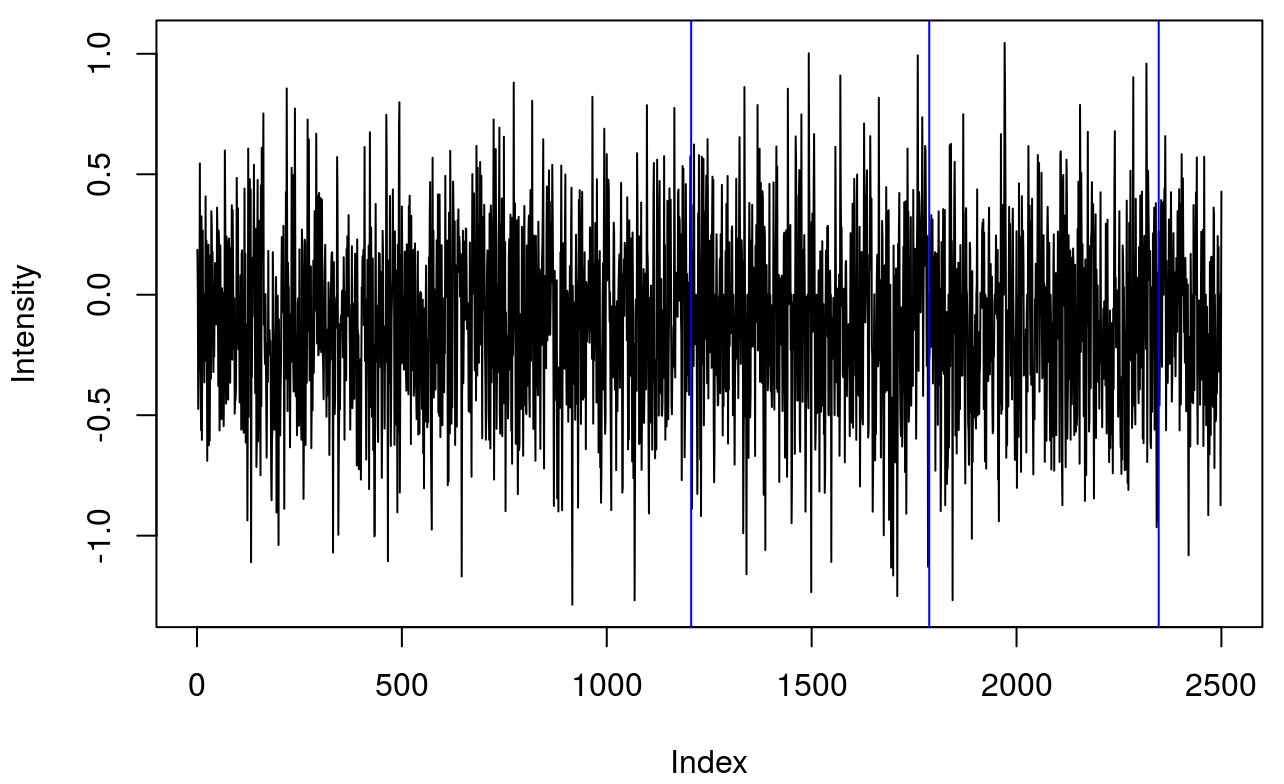
and a plot of the raw data for one channel (rather noisy) with all the triggers marked. 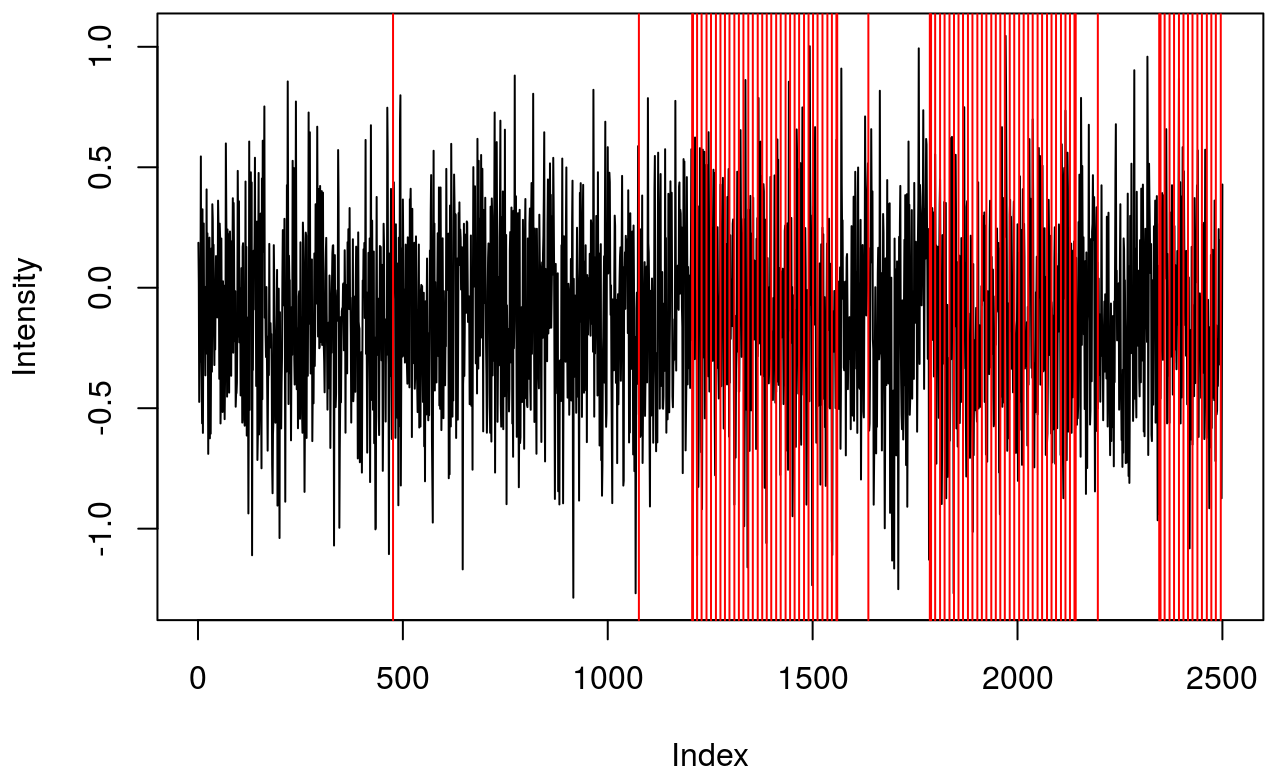
There are several triggers here (all shown in red). I only want to keep trigger ‘2’, which marks the start of a block, so the first step is to strip out everything else. That leaves fewer events: 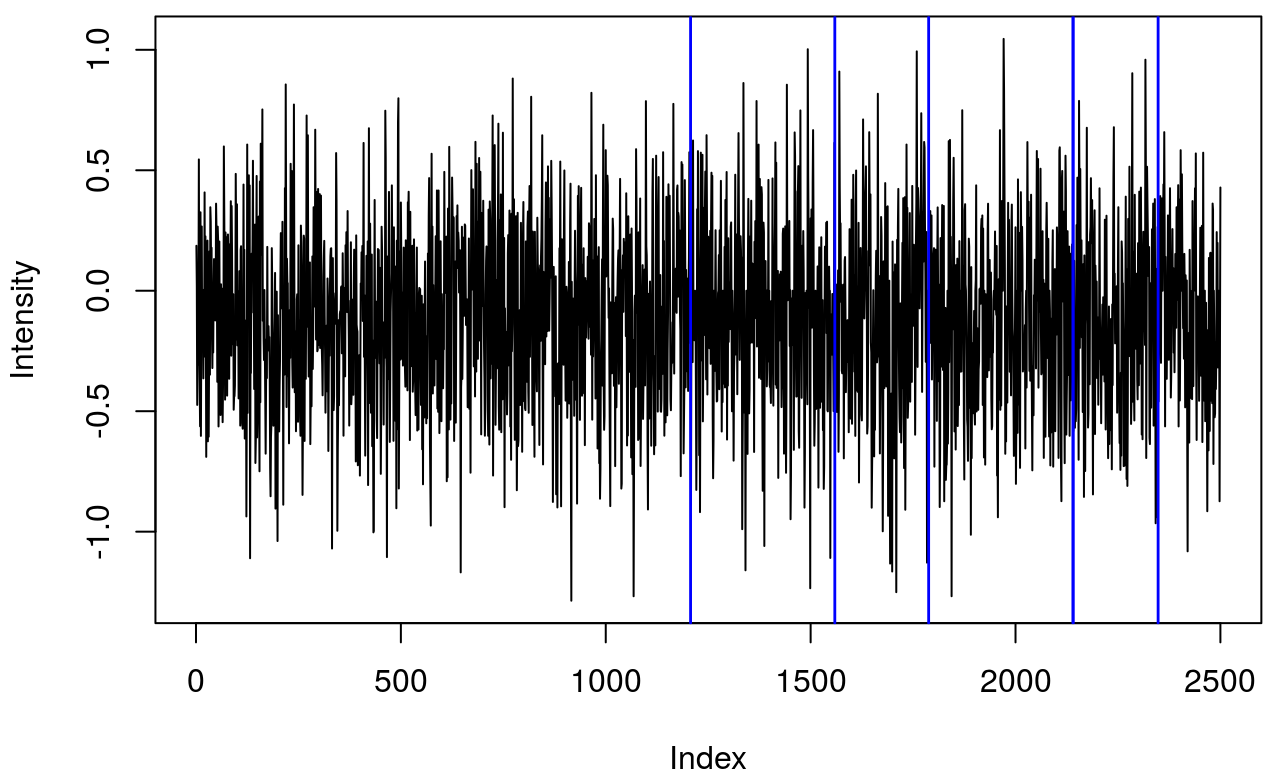
It turned out there were two ‘2’ triggers side by side. This is because the ETG-4000 doesn’t allow odd triggers next to each other — 212 is invalid, but 22111122 is fine. I wrote a function (soon to be folded into the fnirsr package) to handle this. The result, showing only the first block’s events, is below: